When I first heard the terms penetration testing and red teaming, I assumed the difference was simple: pentesting is what you do alone, and red teaming is what you do with a group. I held that belief until I asked a senior analyst why a red team engagement cost ten times more than a standard pentest. He said: "A pentest finds holes. A red team breaks in, steals the crown jewels, and proves your security team never noticed the alarm." That single sentence destroyed my mental model. I realized I wasn't comparing tools or team sizes. I was comparing two completely different philosophies of attack.
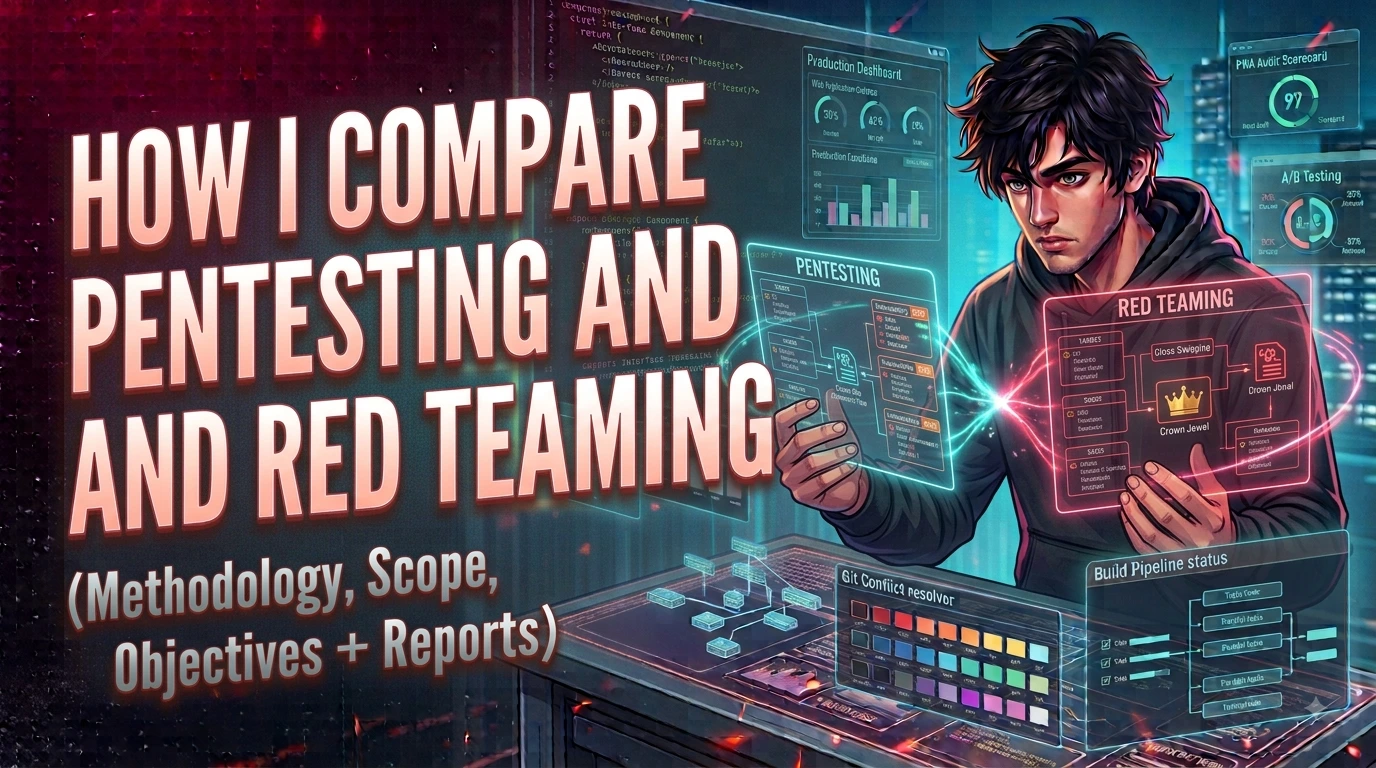
I'm breaking down the real difference between pentesting and red teaming — why one is a vulnerability scan with proof-of-concept and the other is an adversary simulation designed to test detection and response. I'll also explain why AI can assist pentesting but still misses the point of red teaming entirely.
What Pentesting Actually Is
Pentesting is a scoped, time-boxed security assessment. You get permission, you receive a list of targets, and your job is to find as many vulnerabilities as possible within those boundaries. You discover a SQL injection, you prove it works with a screenshot or a minimal data dump, you write it up with a risk rating, and you move on. The goal is breadth and documentation.
You're not trying to hide. In many cases, you want the client to see you coming so they can verify their logs are catching the activity. You might run automated scanners, manually validate findings with Burp Suite, and produce a PDF report with CVEs and remediation steps. The value is in the inventory of weaknesses.
What Red Teaming Actually Is
Red teaming is an objective-driven adversary simulation. You don't get a list of targets. You get a mission: access the payroll database, exfiltrate customer PII, or achieve domain administrator privileges without triggering an alert. The goal isn't to find every vulnerability. It's to find the path of least resistance and exploit it silently.
You pivot between systems. You establish persistence. You use social engineering, physical access, or living-off-the-land techniques that don't leave malware signatures. You avoid detection not because you're sneaking around illegally, but because the entire point is to test whether the blue team can see you and stop you. The final report isn't a list of CVEs. It's a timeline of how you moved through the environment and which defensive controls failed to fire.
The Difference Most People Miss
Pentesting answers: "Are we vulnerable?" Red teaming answers: "Can our people, processes, and technology detect and stop a determined attacker before real damage happens?"
A pentest might find twenty vulnerabilities and call it a success. A red team might find only one vulnerability, exploit it to reach the CEO's mailbox, and sit there undetected for three weeks. The red team engagement is more valuable because it proves the organization's response is broken, not just its code. You can patch twenty CVEs and still lose the company because one phishing email worked and nobody noticed the outbound connection.
I've done solo red team exercises and team-based pentests. The headcount isn't the difference. The intent is. If your scope is wide open and your goal is "find bugs," you're pentesting. If your scope is "the entire company" and your goal is "get the data without getting caught," you're red teaming.
What AI Can and Cannot Automate
People ask whether AI will replace pentesters. The honest answer is that AI can automate the boring parts of pentesting — scanning, vulnerability identification, report drafting, and even some exploitation like basic SQL injection or XSS payloads. That helps. It speeds up the work that is repetitive and pattern-based.
But red teaming? AI can't simulate adversarial creativity. It can't improvise when a network path closes. It can't decide to drop a USB drive in the parking lot because the phishing campaign failed. It can't read the body language of a help desk employee during a phone pretext. It can't judge whether exfiltrating data now is worth the risk of detection, or whether to wait until the security team's shift change. Those decisions require context, intuition, and operational security judgment that no model currently possesses.
I use AI to speed up pentest report writing and analyze scan output. For red teaming, I might use it to research target infrastructure or draft phishing templates, but I would never let it choose my pivot strategy. Strategy is human. Deception is human. Knowing when to back off because a defender is getting suspicious — that's human.
Production Checklist
These four rules keep me from confusing the two disciplines or selling one as the other:
- Don't call a pentest a red team just because you want it to sound advanced; if the scope is "find bugs" and you're not testing detection, it's a pentest
- If you're hiring for red teaming, look for adversarial mindset and operational security experience, not just CVE knowledge; a great pentester isn't automatically a great red teamer
- Use AI for automation and recon, but never let it replace the human decision loop in red teaming; creativity and deception are not algorithmic
- Always debrief the blue team after a red team engagement; the findings are worthless if the defenders don't understand how they were bypassed
I used to think the difference was team size. Now I know the difference is depth. Pentesting is about finding the door. Red teaming is about walking through it, taking what you came for, and proving nobody heard the footsteps.
The Penetration Testing Methodology
Professional penetration testing follows a structured process. The industry-standard framework is PTES — the Penetration Testing Execution Standard — which breaks a test into seven phases that any serious engagement should move through.
Pre-engagement is where scope is agreed in writing. Which IP ranges, domains, and applications are in scope? What is explicitly out of scope? What are the testing hours? Who is the emergency contact if something breaks? These questions are not bureaucratic overhead — they are the legal and practical boundaries of the work. Skipping this phase is how security researchers end up in legal trouble despite acting in good faith.
Intelligence gathering is the reconnaissance phase: OSINT on the target, subdomain enumeration, service fingerprinting, identifying the technologies in use. The goal is to build a complete map of the attack surface before attempting anything. Threat modeling uses that map to prioritize: given what we know about this organization's data and infrastructure, what are the most impactful things an attacker could do? This shapes the test plan.
Vulnerability analysis identifies weaknesses without necessarily exploiting them. Exploitation attempts to leverage those weaknesses to gain access or demonstrate impact. Post-exploitation — which is more common in red team engagements but increasingly present in mature pentests — explores what an attacker could do after gaining initial access: pivoting to internal systems, escalating privileges, accessing sensitive data stores. Finally, reporting translates all findings into clear, actionable documentation for the client.
The report is the deliverable, not the exploit. A pentest that produces a list of vulnerabilities without clear severity ratings, business impact descriptions, and actionable remediation guidance is far less valuable than one that gives the client a prioritized action plan they can actually execute.
Red Team Operations in Practice
A red team operation is designed to simulate a real adversary pursuing a specific objective. Where a pentest asks "what vulnerabilities exist," a red team engagement asks "can a motivated attacker achieve this goal without being detected by our security team?" The goal might be: exfiltrate a specific file from the finance department, gain domain admin access, or demonstrate that a ransomware deployment is feasible.
Red team operations use the full range of adversary tactics. Initial access might come from a spear-phishing email with a custom payload, an exploited external service, or physical access to a building. Once inside, the team establishes persistence — a way to maintain access even if the initial foothold is removed. They move laterally through the network, escalating privileges and accessing internal systems. Throughout all of this, the primary operational concern is stealth: staying below the threshold of detection by the blue team's monitoring tools.
Red teams build their own C2 (command and control) infrastructure — servers that receive beacon callbacks from implants on compromised systems. Commercial tools like Cobalt Strike or open-source alternatives like Havoc and Sliver provide these capabilities. The implants communicate over protocols — HTTPS, DNS, or custom channels — designed to blend in with normal network traffic.
The Purple Team Model
The traditional red vs blue model treats offensive and defensive teams as adversaries. The purple team model recognizes that this framing limits the value of each engagement. If the red team finds something the blue team's detection doesn't catch, and simply records it as a finding in a report, the blue team's detection doesn't improve. If the red team and blue team work collaboratively — the red team using a technique, immediately followed by the blue team tuning their detection to catch it — the organization gets a detection improvement in real time, not six weeks later when someone gets around to reading the report.
Purple teaming is most valuable for mature security organizations that already have functioning blue team operations. For organizations that are still building baseline visibility, a traditional pentest or red team engagement that produces a gap analysis is more appropriate. The value of purple teaming is compounding: each collaborative exercise directly improves the detection surface, and the improvement sticks.
Building Your Own Lab
You cannot develop offensive security skills without a safe place to practice them. There are two approaches: using dedicated practice platforms, or building a home lab.
Practice platforms are the fastest way to start. HackTheBox offers a constantly rotating set of intentionally vulnerable machines at varying difficulty levels, closely mirroring real-world systems. TryHackMe provides more structured learning paths and guided rooms ideal for beginners. Both platforms require a subscription for full access, though free tiers offer substantial content. PentesterLab focuses specifically on web application vulnerabilities with realistic challenges.
A home lab provides deeper control. The setup I recommend: a host machine running a hypervisor (VirtualBox or VMware Workstation), a pfSense VM acting as a firewall and router to isolate lab traffic from your home network, a Kali Linux attacker VM, and several vulnerable target VMs from VulnHub — Metasploitable 2, DVWA, and VulnHub's collection provide hundreds of practice targets. The pfSense isolation is important: vulnerable VMs should never be on your regular home network.